
This guide contains Amazon affiliate links. If you buy through them we may earn a commission at no extra cost to you. We have not hands-on tested these products; recommendations are based on welfare guidance and manufacturer specifications.
The most useful “toys” for a hamster are the ones that let it behave naturally: a multi-chamber hide to nest in, cork and wooden tunnels for cover, a sand bath for grooming, safe wood to gnaw and seed sprays to forage. Skip exercise balls, which Blue Cross, Woodgreen and TVT advise against.
Hamsters do not play with toys the way a dog or cat might. What keeps them busy is digging, hiding, chewing, grooming and searching for food. Enrichment that supports those behaviours is worth buying; novelty items mostly are not. We have not tested the products below; they are chosen by matching manufacturer details to welfare guidance.
What welfare sources recommend
| Need | What to provide | Source |
|---|---|---|
| Nesting and hiding | At least three hides; a multi-chamber house for sleeping, ideally sunk into the bedding | TVT, Blue Cross |
| Cover | Cork logs, wide tunnels, branches, low wooden items | Blue Cross, Woodgreen |
| Grooming | A sand bath kept in the enclosure | Blue Cross, Woodgreen, TVT |
| Gnawing | Fruit-tree wood such as apple or pear | PDSA, Blue Cross, Woodgreen |
| Foraging | Scatter-feeding, millet and seed sprays | Blue Cross, Woodgreen, TVT |
| Digging | Deep bedding and a dig box | PDSA, Woodgreen |
Hideouts
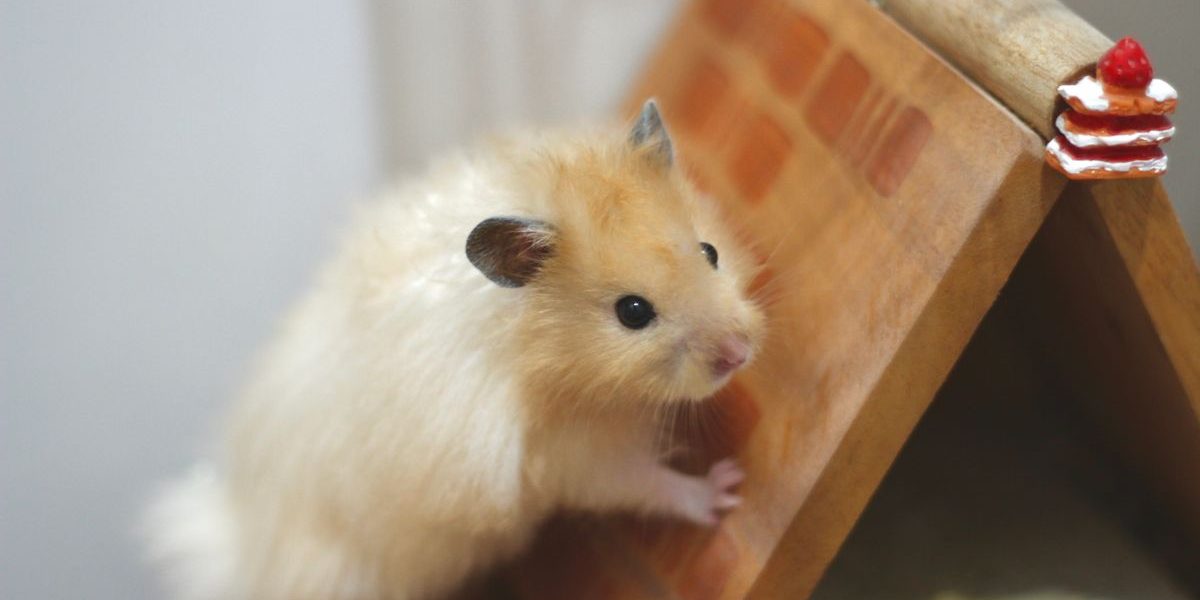
Niteangel Multi-Chamber Wooden Hideout
A bottomless wooden house with six rooms and two entrances, so the hamster can dig down from inside it. The maker lists two sizes: a large at 16.9 x 11.2 in with doorways of roughly 7 cm, aimed at Syrians, and a small at 12.4 x 8 in with roughly 5 cm doorways for dwarfs. Those doorway sizes match the widths TVT suggests for each.
Best for: A main sleeping hide, part-buried in the deep end of the enclosure.
Why consider it
- Multi-chamber design recommended by TVT and Blue Cross
- Open base lets the hamster extend the nest downward
- Doorway sizes suit Syrians (large) and dwarfs (small)
Think twice if
- Your enclosure is small: the large takes up real floor space
- You have a strong Syrian: the maker suggests weighting the lid
Product details are taken from manufacturer information and listings, not hands-on testing. Check the current listing for sizes and price.
Tunnels and cover
Cork logs and wide wooden or cardboard tunnels let a hamster cross the enclosure without feeling exposed. Blue Cross and Woodgreen both list cork logs and grapevine. TVT suggests tubes at least 7 cm wide for Syrians and 5 cm for dwarfs, and advises against plastic tube systems.
Sand baths
Hamsters roll and dig in sand to keep their coat in condition. TVT recommends permanent access to a tray of at least 20 x 20 cm, and Blue Cross says a large sand area matters most for Roborovskis. Woodgreen suggests a glass oven dish as a container, which is cheap, heavy and easy to clean.
Which sand? Choose fine, round-grained sand rather than powder. PetMD recommends chinchilla sand, not dust, because dusty products can irritate eyes and airways. TVT advises against sharp quartz sand, bird sand and builders’ sand. We could not find authoritative guidance on children’s play sand or reptile sands for hamsters, so we cannot recommend a specific one of those; whatever you choose, it should be unscented, undyed and not dusty.
See hamster bathing sand on Amazon
Chews
Hamster incisors grow continuously, and PDSA lists safe gnawing material as the way to help prevent overgrowth. PDSA names apple, pear, hazel, willow, hawthorn and grapevine among safe woods. Woodgreen advises against coloured chew sticks and mineral or salt blocks.
See apple wood chews on Amazon
Foraging
The cheapest enrichment is to stop using a food bowl. Scatter the daily ration, tuck some into a cardboard tube stuffed with paper, and stand a millet spray in the bedding. TVT describes small pieces of millet or grass seed heads as good foraging food.
Quick comparison
| Item | Supports | What to check | Listing |
|---|---|---|---|
| Multi-chamber hide | Nesting, hiding | Doorway width for your species | View on Amazon |
| Cork log or tunnel | Cover, climbing, gnawing | Inside width: 7 cm Syrian, 5 cm dwarf | View on Amazon |
| Sand bath and sand | Grooming, digging | Sand, not dust; tray at least 20 x 20 cm | View on Amazon |
| Fruit-wood chews | Tooth wear | Untreated, uncoloured wood | View on Amazon |
| Seed sprays | Foraging | Plain, no added sugar or colouring | View on Amazon |
Free and DIY ideas
- Cardboard tubes and small boxes with doorways cut in.
- A paper bag or egg box with food hidden inside.
- A dig box: a deep container of bedding or coco-fibre placed in the enclosure.
- Rearranging one or two items after a clean.
What to skip
- Exercise balls. Blue Cross says they must not be used; Woodgreen and TVT also advise against them. PetMD and Merck allow short supervised sessions, but a secure playpen does the same job without confining the hamster.
- Hamster harnesses and leads, which TVT classes as contrary to welfare.
- Plastic tube systems.
- Coloured or flavoured chew sticks, and mineral or salt licks.
Frequently asked questions
Do hamsters get bored?
Welfare sources stress that a wheel alone is not enough. A hamster with little to dig in, forage for or hide under may spend more time bar chewing or pacing. Varied enrichment helps.
How often should a sand bath be cleaned?
Woodgreen suggests spot-cleaning it daily. Many hamsters use part of their sand as a toilet, so sieve or replace it as needed.
Are wooden toys safe?
Untreated wood from safe species is recommended by PDSA, Blue Cross and Woodgreen. TVT advises unsprayed branches and no conifer wood for dwarf hamsters.